Note: I wrote this post this morning but am only now getting a chance to post it.
After spending approximately 17 hours in a plane (24 hours if you count the time 9 hour time difference from Portland) I made it to The Netherlands. The flights were fairly uneventful except for some US Airways customer service problems. In Portland I was in boarding zone 5 which meant that I was one of the last people to board the plane. Because other passengers had brought so many carry on bags there was no space and I was forced to gate check my bag. The plane was at maximum weight capacity, and the ground crew in Portland ended up over-fueling the plane by about 100 lbs. so we sat on the tarmac for 20 minutes with the engines running in order to burn off the excess jet fuel. Over-fueling seems like quite an expensive mistake to make in terms of cost, environmental impact, and time loss. The delay on the Portland tarmac caused the plane to land in Phoenix at the exact time my connecting flight was beginning to board so I got in some cardio by having to sprint from one terminal to the next. Luckily I made it to the plane and the flight to Philadephia arrived on time and did not require sprinting.
I arrived in Amsterdam Schipol, made my way through passport control and customs and headed for the trains. Schipol is only about 35 minutes from The Hague by train. That is, of course, if you get on the correct train. There are multiple trains routes that run through The Hague and multiple train stops in The Hague, but not all of the routes stop at the Central Station. When looking at the train schedule I had just looked for The Hague and assumed that the train would stop at the Central Station. This was a big mistake. Luckily I figured the mistake out while I was at the last stop in The Hague (and only 3 minutes away from the Central Station) instead of when I had arrived in Rotterdam or some other city.
At the train station, Gerbrand, a friend and neighbor of my landlords (who are currently vacationing in Spain), picked me up and drove me to my new apartment. Gerbrand is a very nice older man who works in the library at the Peace Palace (where the International Court of Justice and the International Court of Arbitration are located – I’m hoping to arrange a tour through him as the building is closed to visitors). He also hosts a few interns in his apartment, which is located in the same apartment building where I’m living and we will all (the three other interns I live with, the two interns that live with Gerbrand) be getting together for coffee sometime in the next week.
My new apartment is quite small but it is cozy and in an ideal location. The building is located in the international section of The Hague (which is where all the embassies and international courts are located) across from the Peace Palace and the main police station. I believe I am only about a 30 minute walk or 10 minute tram ride away from where I will be working.
The apartment has 4 bedrooms, each of which is occupied by a law student from a different country. It also has a shared kitchen, living room, and bathroom. Two of my roommates are also interning at the International Criminal Tribunal for the former Yugoslavia (ICTY). Anna Clara (from Brazil) is in the Office of the Prosecutor and I’m not sure which section Marion (from France) is in, as she has not yet arrived. Lynnette, my third roommate (from Kenya / the U.K.) has actually already graduated law school and currently works at the International Criminal Court.
There is a supermarket close by the apartment and I was thrilled to learn that it is open 7 days a week and on Monday – Saturday it is open until 10 p.m.! While we are used to grocery stores being open 7 days a week and long hours of operation in the US, I was preparing for operating hours that were similar to those I experienced in Germany. In Germany the supermarkets were only open Monday – Friday and on Saturday until about noon. If a holiday backed up to a weekend, the supermarket would be closed for days (I learned this the hard way when I lived in Germany and returned from my EU seminar late the Thursday before Good Friday and had no food in my cupboards or refrigerator). Since the supermarket would be open on Sunday, I was able to purchase just what I would need for Wednesday night dinner and Thursday breakfast and lunch.
After the quick trip to the grocery store I took a short nap and went to work unpacking. It didn’t take too long to unpack and it felt nice to be situated. Anna Clara’s mother is currently visiting and she cooked a delicious dinner of bruschetta, seasoned beef, and potatoes for Anna Clara, Lynette and I. It was so nice of her to cook dinner for us and I have a feeling that we will be spoiled during the next two weeks she is here because she has already informed us she will be cooking a Brazilian rice and beans meal. Lynette has also offered to cook a Kenyan/British fusion dish at some point in the next two weeks. I would love to cook something as well, but need to figure out what a good “American food” dish would be. Suggestions for something to cook are more than welcome in the comments below.
Dinner was a nice way to spend the evening getting to know my roommates. I look forward to spending the next two months with them (Anna Clara is only in The Hague until the beginning of March and Lynnette will have to change to another apartment at the end of February). After dinner and some more chatting, I retired to my room to sleep.
Thursday morning I packed some clothes into a carry on bag and headed for the train station to catch a train to Cologne, Germany. I will be in Cologne visiting my German family until Saturday evening. It was a bit surreal being on the train and passing through Duisburg (where I lived in 2007 – 2008). It almost feels as though I never left. There is snow / ice on the ground here (from the big snowstorm a few weeks ago and the current rain) which is an unusual sight to behold. Romy, my “German mother,” told me that Thursday (yesterday) was the first day she was able to drive in over 3 weeks!
It’s time to bring this first post to a close and enjoy some German breakfast (which I’ve been looking forward to for days!). In Germany, for breakfast there are always brötchen (rolls) which can be topped with cheese or meat or nutella (tons of options) and lots of coffee. Breakfast is a truly relaxed and enjoyable experience – which is probably why they have a verb in German which means “breakfasting” (Frühstucken). So I’m off to breakfast.
Friday, January 7, 2011


Friday, March 21, 2008
EU/NATO Seminar

This month I had the opportunity to participate in a week long seminar about the European Union, NATO, and their relations with the United States. Throughout the course of the week we were given the opportunity to speak with diplomatic officials and bureaucrats from both the U.S. and Europe. We were wined and (mostly by the Fulbright commission, although NATO did pay for one of our meals) - I am now afraid to step on a scale after our week of three course meals. There were 35 total Fulbright participants - of whom only about 10 or less had just completed their BA. Most of the participants were MA or PhD scholars. It was refreshing to speak with other Fulbrighters from different countries - many of them older and more experienced and wrack their brains about opportunities and possible paths to take in my future.
This seminar was possibly one of the most informative and interesting events that I have ever participated in in my life. I have a new motivation for my project and feel more engaged in learning and discussing issues - a part of me that I had sort of forgotten in the past few months of being a member in the German University system. I am now re inspired with regards to my research project and I discovered new angles to focus on and explore.
Below I will give a break down of the week and what I experienced and some of what I learned by day. This is very much abridged as my brain took in so much information over the course of the week and I don't have the energy to relate it all. At a date in the future I plan on reorganizing and typing my notes and will gladly make those available to anybody who is interested in learning more about these bodies.
Day 1 - Arrival, Departure to Luxembourg:
I arrived in Brussels (after an early morning of train travel) in order to meet other participants and catch the bus to Luxembourg. Originally we were scheduled to attend a dinner at the U.S. Embassy in Luxembourg, but due to an untimely death our dinner was canceled and we ended up spending time in the hotel and getting to know one another instead. Dinner was still excellent - we just didn't have the opportunity to speak with the U.S. Ambassador.
Day 2 - Court of Justice, Lunch with the U.S. Deputy Ambassador, Court of Auditors:
We left the hotel in order to view a court session at the European Court of Justice. This court cooperates with the individual courts of all the EU nations and it takes action against countries for failure to act or meet EU obligations. It also reviews certain decisions of the EU and evaluates whether or not a Country's law or EU law should apply to certain situations. There are 27 Justices on the Court (one for each member country) and 9 advocates general who sit in on proceedings and make unbiased recommendations to the justices for a ruling. Only 1 advocate general sits per case and typically Justices sit in combinations of 3, 5, or 9 depending on how complex they believe the issue to be. When an issue concerns a particular country's law the Justice from that country typically is seated for the proceedings in order to answer the questions of the other Justices about that country's law. When the justices deliberate they meet in secret without any translators, staff members, or advocates general. Deliberations are conducted in French. The votes they cast are secret and there are no dissenting opinions that are issued (as is the case with the U.S. Supreme Court).
The case that we watched was a matter of Italian law v. EU law as it applied to debtors/creditors and the differences in collecting payment between private and public entities - not the most entertaining of cases that I think we could have witnessed and in fact it was difficult to follow without extensive background. One of the Justices actually fell asleep during the proceedings - interestingly enough we had been warned by the Court not to fall asleep as that would be considered rude. The most interesting part of the proceedings was the fact that at the beginning there was about 30 minutes spent reading the opinions of the court on other cases and those opinions were all read in different languages. When the case is concerning a particular country then the proceedings are conducted in the language of that country. Similarly it was interesting to watch all the translators in their window boxes as they interpreted the Italian proceedings into English, French, Slovak, and German.
After watching the proceedings, we headed to a delightful lunch in which the U.S. Deputy Ambassador to Luxembourg was in attendance. He was - in his own words - our consolation prize for the missed dinner the night before. I was fortunate enough to be seated at his table and partake in his discussion about U.S. Politics - especially foreign policy, how he anticipates policies to change after the election (he does not expect much to change - other than other countries will at least for a short time be more excited to engage with us), and how to become a diplomatic official.
After lunch we were escorted to the Court of Auditors where we met with the British Court Auditor's Chief Aid, Peter Welch. The Court of Auditors reviews the budgetary spending of the EU and creates reports that explain whether or not the money is being spent as it was planned and whether or not objectives are being met. He explained that in the EU budget about 50% of the money goes to farm subsidies, 1/3 to Social Security policy, 1/6 to research, 1/6 to external aid, and 1/6 to administrative expenses.
I was expecting the Court of Auditors to be incredibly dull due to the fact that it is an institution of accountants, however, Mr. Welch's wit and speaking style were surprisingly entertaining and it made it enjoyable to learn about the subject and engage in a discussion on monetary issues.
Finally we loaded up the bus and headed back to Brussels where we would spend the remainder of our time.
Day 3 - European Commission Briefings:
On Friday, March 14, 2008 we spent the entire day in the European Commission (the executive branch) , speaking with various bureaucratic officials. We learned about th
 e EuroZone -where countries are on the Euro and how the concept of the Euro Zone was created, the EU's potential enlargement (and the prospect of Turkey becoming a member), EU structural reforms, the European Neighborhood policy (in which the EU cooperates with neighboring countries and provides them with targeted aid and incentives in order to become more democratic), the EU security policy, and EU/US relations.
The speakers were very impressive and it amazed me at how frankly they spoke with us about various issues. I don't want to bog everyone down with the details, but if you have any questions you may feel free to e-mail and ask me as I took extensive notes and feel like I now know a lot.
Day 4 - College of Europe, Brugge Tour:
On Saturday, we headed to Brugge in order to have a lighter day and tour the city of Brugge (which is called the Venice of the North). Brugge is a preserved Medieval City -
 the street pattern has never changed, largely because of the earlier poverty of the city. It was the original large trading post between the North and the South and as a result was prosperous until the trade routes were moved to Antwerp and then to Amsterdam.
Our first objective in going to Brugge was to attend a sales pitch at the College of Europe. The sales pitch itself was not that interesting, but we were also given a lecture on the politics of European monetary policy. The lecture on monetary policy was informative. According to the policy, much of the expansion within the EU is in order to preserve growth. The Eastern European countries have room for their economies to expand and they have labor resources that the aging Western European countries need.
After our lecture and lunch we were given a tour of Brugge. It is a lovely city and
 provided the breath of fresh air in a quaint village that was needed after 1/2 a week of intense seminars in a large city. The city is now overpopulated with tourists, but it was an enjoyable day filled with walking around, learning about the city history, and sampling chocolate.
The fact that Belgium is so small and that you can easily make it from Brussels to another city within about an hour adds to the livable atmosphere of Brussels. We returned that evening to Brussels and later that evening we met up as a group at the bar Delirium which hosts the Guiness World Record for the most beers on the menu - 2,004!
Day 5 - Unscheduled (Sunday) visit to an open-air market, the Town Hall, and Horta Museum:
Sunday was a free -day and so I went with a small group of other Fulbrighters to a large open-air exotic market. The market was mostly run by an immigrant population and was complete with fresh fruit and vegetables, baked goods, other food items, and of course junk. I was delighted to find some fresh strawberries and fresh nuts that made for a delicious (lighter than the rest of our meals - which was needed) lunch. After the market we began our stroll towards the Brussels castle, however, after misreading our
 map (5 Fulbright fellows - go figure) and receiving 3 sets of incorrect directions, we never made it there. We ended up by the Town Hall (Hotel deVille) after a lot of wandering around and sat on the steps in order to eat our impromptu picnic lunch. Then we wandered further, first to a cafe for some coffee and a bathroom and then to the Horta museum. The Horta museum is the old house/office from Victor Horta - a art nouveau architect. His house was spectacular - elegantly designed and decorated in the art nouveau style (pictured at right).
Our group split into two after the Horta museum - half returned to the hotel and the other half (which I was a part of) headed off towards the center of Brussels to explore the famous chocolate shops and look over the entire city. It was an enjoyable stroll and I took a lot of great pictures. I did not buy any chocolate at this point - primarily because the chocolates at places like Pierre Marcolini (the most famous of the shops) was incredibly expensive and I wasn't convinced that it was worth that price when there are other nice chocolate shops around in which the chocolate is not cheap but it is not that expensive.
Day 6 - Council of Ministers, U.S. Mission to the EU, and the European Parliament:
The day started out with a visit to the Council of Ministers where we were briefed about the outcome of the European summit that had finished up the previous Friday. The council set legislation for issues like climate change, external relations, immigration, and security. The decisions by the council are political intentions, but as it is only a political intention it has no legal weight and cannot be challenged if nothing comes about from it. Our speaker, Wolfgang Ploch, was well versed in the workings of the council but primarily in issues related to climate change. He commented on how the EU has gained astonishing importance even in just the past 15 years and that although it has a ways to go in gaining authority on some issues it has made leaps and bounds.
After the Council and another delicious lunch we headed to a briefing by the U.S. Mission to the European Union. At the beginning we met with a public affairs officer who explained a bit about the mission but after a short introduction from him we had the opportunity to speak with - or should I say be tongue-lashed by Special Envoy Gray. It should be noted that Special Envoy Gray was a Bush recess appointment as he would likely not have been confirmed by the Senate. He is a staunch Republican and immediately came out swinging at our group after somebody asked a question about climate change and the U.S. failure to sign Kyoto. He immediately became sort of agitated and made the claim that nobody would ever give credit to a Republican for passing something environmentally favorable (to which our group responded by naming Schwarzenegger and the first Bush among others). He also called our group un-American (and it should be noted one of our group members is a member of the Armed Forces), overly critical of our government, and biased by the liberal media (again it should be noted that about 5 group members are journalists). It was shocking to have a diplomatic official address individuals in such a manner and I certainly hope that he does not conduct diplomacy in such a manner as that certainly will not help the U.S. image abroad. Our program director was of the opinion that he was seeking to challenge us and engage in a rousing debate, however, I think that it could have been done with a little more tact and respect. Special Envoy Gray did make a few comments with which I have to agree. He noted that this election - with both Hillary, Obama, and McCain running is historical (a woman, an African American, and the oldest candidate) and that it demonstrates to Europe our ability to integrate - not perfectly but certainly better than Europe itself is able to integrate with various minorities. He also noted that a good reason to be ashamed of America and the government would be the subprime Mortgage crisis and again I must agree. Although there are numerous other problems within our country that is one that has large implications for both our domestic and foreign situation and it really should not have occurred in the first place.
Finally, after an intense emotionally stirring experience we finished off our day with a speaker, Michael Shackleton (who is the author of a book on the subject), on the European Parliament. Like the other British speakers I was impressed with his ability to speak candidly, convey a great deal of information and utilize humor so as to keep it entertaining. Mr. Shackelton pointed out, that like in the U.S., there is a great deal of ignorance and apathy within the EU citizens when it comes to elections and that often the greatest voting turnout occurs when the EU elections coincide with the National elections.
Day 7 - NATO Headquarters:
Tuesday, a day immediately after NATO forces in Kosovo had been active due to a Serbian attack along the border, our group headed to NATO in order to learn about what the organization does. Once again our speakers were excellent and I learned an incredible amount about the inner-workings of NATO and the 21st Century Challenges it is facing.
Kosovo, Afghanistan, Iraq, and Chad were the primary topics in terms of current missions but it was interesting to learn that NATO conducts both civilian and military operations in those countries. There are of course numerous other operations that NATO has conducted in the past and that they are conducting at present. It was interesting for me to learn about the successes the organization has seen and also the partnerships that it forges with other countries on certain projects. Russia, for example, has actually cooperated significantly with NATO on Operation Endeavor in the Middle East and shows interest in further cooperation. In addition to learning about the organization itself we also spent some time discussing the relationship between the EU and NATO and the US and NATO. The EU actually has structured their defense policy around being able to utilize NATO in order to round up forces (which all are actually member government forces - NATO has no army or weapons of its own and relies solely on members to provide resources when needed) and respond to crises.
Day 8 - SHAPE Headquarters:
SHAPE is the command center where all allied military operations worldwide are conducted. We had been informed in advance that SHAPE would not really tell us a whole lot of information or answer questions - and with our first speaker that appeared to be the case. The powerpoint that he shared contained interesting information but his monotone voice and speaking style made it less interesting. Unlike the other institutions and speakers, I think that most information that was shared with us was actually information that is available on the website.
Our second speaker was surprisingly interesting - he was another British gentleman who again blended wit with information. He detailed the process of the EU utilizing the NATO system in order to provide their own defense and run their own operations should the need arise. He was much more willing to answer questions and speak in a manner that was not limited to information from the website.
Finally we finished our day with a panel discussion between the two previous speakers and an American Lieutenant. This panel consisted solely of our group asking questions and hearing the perspective from three different individuals representing three different countries and three different divisions within SHAPE. It was interesting to hear how the Armed Forces get along and to hear anecdotal stories of how the groups play sports in their free time but usually as a unit and not as a country in order to promote cultural cooperation and understanding since they are all working towards the same goals.
That night we had our closing dinner - conducted our final discussions as a group and then headed one last time to the bar Delirium in order to celebrate the conclusion of a great week.
Day 9 - Exploration of a Few Parks in Brussels, Chocolate Factory, and a Return to Germany:
On the final day in Brussels a few of us decided to explore a few of Brussels parks and walk around a bit enjoying the general aesthetics. It was enjoyable to stretch our legs and enjoy the fresh air after a week of mostly sedentary existence and overeating. Brussels also has an Arc d' Triomphe, like Paris and it is contained in a large park. The park also contained a monument that was erected to celebrate Belgium's colonial past - which struck me as being unusual in that you don't often find countries to have monuments celebrating their imperi
 alism.
After walking for a bit we headed to the "best fries" in Brussels. It was at first hard to stomach the idea of greasy food after having ingested so much over the previous week, however, I think we were all of the idea that we should live it up and experience it while you can. The fries were quite delicious - a nice texture and a good flavor, however, I am not sure what qualifies them as the "best" in Brussels. Having finished our fries we then boarded the metro in order to head to the Neuhaus chocolate factory where people can buy the deluxe pralines for a price more reasonable than the store they have downtown. The only downside was that they had to be purchased in large quantities (3 kg!!) but we were luckily a group of 4 and were able to purchase that much and divide the spoils amongst ourselves. It is still a large amount of chocolate but luckily pralines are not something that spoils quickly and it makes for nice gifts.
After our venture into the boonies seeking chocolate I headed to the train station and boarded my train back to Germany. The train ride was mostly uneventful until I reached Dusseldorf where the train was boarded by a large group of unruly teenagers (who did not have school today due to Good Friday) who were drinking and then had the audacity to begin smoking on the train (although it is not allowed). Despite the fact that there were numerous adults on the train who were annoyed by the smoking and the loud nature of the group I was surprised that NOBODY said anything to them. It is interesting how afraid the Germans are of asserting authority and how they allow their high school aged children to run around as they please - something that has been attributed to their difficulty in coming to terms with their Nazi past. Luckily I only had to tolerate this action for about 10 minutes when I was finally back in Duisburg and able to get off the train.
Another thing that caught me by surprise being back in Germany was the fact that everything (grocery stores!!) was closed today due to the fact that it was Good Friday. I was happy that I purchased an Apple and some crackers yesterday in Brussels and that some food stands were open because without those items I would have had to subsist today off my large store of chocolate. Germany seems to make life incredibly difficult at certain points.
Thursday, February 21, 2008
Stockholm: Experiencing Global Warming, Meatballs, Pippi Longstockings and More

On Friday evening, my friend Lena and I left for the Weeze airport so that we could catch our flight to Stockholm. The Weeze airport is situated near the Holland border in the middle of farmland. It takes 45 minutes to get to the airport and due to its inconvenient nature it is also the airport where one can expect to find all Ryanair flights - a very inexpensive airline. Since the airport is small and relatively far away from everything, one would not expect to encounter any problems when departing or arriving to the airport, however, Lena and I arrived to find all the check-in counters barricaded off with police tape and were told that there was a "Security Problem" so we had to check in for our flight at a car rental counter. We also heard an airport employee nonchalantly say "Oh, the bomb squad is here now". It was a strange experience to encounter at such a small unpopulated airport but as the employees and police officers that were there seemed un-alarmed so were we.
We obtained our boarding passes, went through security, and took our 1.5 hour flight to Stockholm. Interestingly enough the airport that Ryanair uses in Stockholm is about 1
 .5 hours away from the city. When all was said and done we spent more time getting too and from the airport than we did on our flight - the price you pay for cheap airline tickets. Luckily both of our flights were in the evening/night so we did not miss out on precious day time hours.
When we arrived in Stockholm we headed immediately for our "boutique" hotel where we were meeting Lena's friend Masha. Masha is an HR Consultant who is currently working in Europe on a project for Shell Oil. As Shell is required to pay for a hotel for her 7 days a week (the working days of which are spent in London) it makes no difference if she travels elsewhere on the weekends - Shell still foots the bill. This worked wonderfully to our advantage as we were able to stay for free at the Hotel Rival which was founded by one of the band members from ABBA. The hotel featured a pillow menu (so that you could choose what type of pillow you would like to sleep on), a dvd/cd player and cds (of course many of which were ABBA) and dvds that you could use free of charge, a flat screen tv, Egyptian cotton sheets, and a general comfortable atmosphere (pictured above right). The hotel also houses a cafe, restaurant, bar, and movie theater. Lena and I spent our last night in a hostel, as Masha had to return to work, and although we were afraid that it would be horribly disappointing after such posh accommodations we actually ended up enjoying it tremendously - more on that below.
On Saturday morning we awoke to sunlight streaming in through the windows. The weather the whole weekend was absolutely wonderful - at times a bit cold (when the sun went down) but overall fairly warm, sunny, and pleasant. Stockholm apparently used to ice over (the ocean and lakes) and get quite a bit of snow, but due to Global Warming that seems to be a phenomenon that no longer occurs. Alas the only image of Stockholm iced over and needing ice breaking boats comes from postcards that were created at an earlier date. Who knows perhaps someday those postcards will be collectors items.
Saturday we spent the day walking around, enjoying the general atmosphere and aesthetics of the city (in addition to beautiful architecture Stockholm also hosts many go
 rgeous people in the downtown/ posh districts - an observation that was also confirmed later by our hostel tour guide), taking advantage of the sales, and trying typical Swedish fare like meatballs mad
 e from Reindeer (pictured at right), Semlas (wheat buns with whipped cream and marmalade type filling - pictured in pastry case at right), and of course herring. During our walking we saw the castle (which the King and Queen do not really occupy and they use mostly for state affairs - the castle they live in is actually on an island outside of Stockholm), the Stockholm city hall and Grand Hotel where Nobel prizes are handed out (although we did not pay a visit to the museum), the Opera, and of course churches. Saturday night we checked out the night life in Stockholm and noticed that people mostly stuck with their groups of friends and didn't really mingle (this fact was also confirmed by our Swedish tour guide who told
 us that a lot of Swedish people are shy but after you make the initial move they are incredibly friendly).
Sunday we again had a leisurely morning and then wandered around looking for a place to eat some brunch. On our way wandering towards brunch we happened upon the Changing of the Guard at the castle (pictured at left). We then ate an enjoyable traditional Swedish lunch - I had the herring platter which consisted of herring marinated in different ways, salad, and bread.
After our delightful brunch we headed towards the ferries in order to take a ferry tour of Stockholm and get a small taste of the Archipelago (24,000 islands that lay just outside of Stockholm - at least 50 square meters - 30,000 islands if you count the smaller ones). On our ferry tour we sat on Reindeer pelts and covered ourselves with polar fleece blankets while viewing Stockholm by boat. The tour guide shared with us many interesting facts about Stockholm and the sights that we were seeing. For example she explained that the reason the Nobel Peace Prize is handed out in Oslo and all the others in Stockholm is that Alfred Nobel thought the Norwegians to be more peaceful than Swedes.
After our boat tour, Masha had to head to the airport to catch her plane and Lena and I headed to check in at the City Backpackers hostel. The City Backpackers hostel was incredibly cozy, friendly, and full of activity. We immediately signed up for a Monday tour that would take us through the less touristy parts of Stockholm and show us the home of Astrid Lindgren (author of Pippi Lonstockings) as well as some of the locations that inspired her stories. The hostel had free pasta (you just needed your own sauce), coffee, and tea. It also had free ice skating rentals, movie nights, and activities going virtually every day. Unfortunately we were not able to partake in the Swedish Sauna tour, Meatball making class, Semla making class, or other events as they were held on the days after our departure. Those activities will best be saved for another adventure. Although it had been nice to stay in our posh hotel, staying at the hostel reaffirmed for me the fact that having a lot of fun and experiencing really neat things does not have to cost a lot of money - and in fact it is a lot of the less expensive, non-trendy area
 s in a city that give you the best feel for how people actually live and the most authentic experience.
Monday Lena and I walked around a bit more, stopped off at a grocery store to buy some food for that day (and wound up with a delicious meatball sandwich, ostkaka, pepparkakor, and drinks - coincidentally items that I know from my family's Swedish heritage that were tasty and also the least expensive of all our meals), and then headed on our guided tour. The tour was hosted by one of the hostel employees and she shared with us a lot of the locations of cool, typical Swedish restaraunts and cafes. If only we had been able to attend the tour at the beginning of the trip - but it was only offered on Monday's and we hadn't stayed at the hostel first. She also pointed out the home of Astrid Lindgren and explained how the idea for Pippi Longstockings came from her ill daughter Karin who was begging her mom to tell her stories and came up with the name Pippi Longstockings. Apparently Astrid Lindgren was also responsible for changing the way Swedes view childhood and child rearing.
After the tour we raced off to the Ice Bar - the first year round bar that is made entirely out of ice - very touristy but an overall cool experience being able to drink out of glasses made from ice, wear large parkas, and sit on Reindeer pelt covered ice stools. Finally it was time for us to say goodbye to Stockholm - a city that ranks among my favorites and a location that I will definitely be returning to one day.
Thursday, February 7, 2008
Interview with a German Newspaper
Most people might be surprised to learn how important U.S. politics are to people in Germany. It is a common experience for me to be questioned about politics here and I'm always shocked to realize that many German's know more than the typical American citizen. As part of this fascination with American politics, my friend Lena and I were interviewed by a German newspaper about what it is like to experience the election from abroad. The article can be found at this link (although it is in German): http://www.derwesten.de/nachrichten//staedte/essen/2008/2/4/news-21090089/detail.html
Interestingly enough, the journalist asked us to meet him at a Starbucks and then the photographer bought an "American Newspaper" - that was in German for us to hold in order to take the photo you see. So despite our best efforts I guess some stereotypical views of Americans still hold true. Clearly it wouldn't have been fitting for us to be in a typical German coffee shop or holding a German newspaper. :)
Interestingly enough, the journalist asked us to meet him at a Starbucks and then the photographer bought an "American Newspaper" - that was in German for us to hold in order to take the photo you see. So despite our best efforts I guess some stereotypical views of Americans still hold true. Clearly it wouldn't have been fitting for us to be in a typical German coffee shop or holding a German newspaper. :)
Karneval - A Tale of Celebrations in Two Cities

Karneval is a yearly celebration that begins on November 11 and lasts until the beginning of lent on Ash Wednesday. It is celebrated around the world (in Venice, Brazil, Louisiana - as Mardi Gras, etc.), but the primary celebration in Germany takes place right here in the Northrhein Westfalia area - the two primary cities of celebration being Cologne and Duesseldorf. Although Karneval lasts for a few months, the biggest celebration days are the Thursday before Ash Wednesday which is known as "Weibefastnacht" or "Women's Karneval" and "Rosenmontag" or "Rose Monday" .

On Weibefastnacht women (and men) don their costumes and go out for a night (and day) on the town filled with drinking, dancing, eating, and merriment. Wearing costumes and being merry tends to be the general theme of Karneval celebrations, but the difference is that traditionally this day also involves the take-over of town hall by all the women. Women also traditionally cut off the ties and shoelaces of men as a sign of usurping power. Typically when a woman cuts off a mans tie or shoelaces she is then supposed to give the man a kiss on the cheek. I decided that I would prefer to watch people cut off ties rather than attempt to do so myself - being as this was my first Karneval I thought it best not to anger someone. Sadly, the only tie cutting I witnessed, however, was later in the evening when my friend Karin cut off the tie of Tim another Fulbright TA who had joined us for the evening - it was a tame reenactment (pictured above).
For Weibefastnacht, my friends and I headed to Duesseldorf (which is only about 20 minutes away). The sight was one of complete and utter chaos - broken glass and garbage all over the ground and thousands of people dressed up and roaming around the old downtown. We spent some time outside enjoying some beers (no open container laws in Germany) and some french fries, but due to the cold decided we should attempt to make it in to a bar. We made it in to one bar and spent some time dancing there before we decided to try to find something new. Finally, we had a stroke of luck and ended up at a typical German brewery where the Karneval royalty/jury was celebrating. Every year a Karneval prince and princess are elected and we were fortunate enough to meet a nice old German man (pictured in the first picture on the right) who was the brother of the prince and who also owned a bakery. This nice man allowed us to share the table with the rest of the jury/royalty and he explained the traditions to us, gave us delicious baked goods, and overall made the night quite enjoyable and filled with more typical German culture. W
 e were also invited to stop by the bakery in Duesseldorf whenever we want to and I'm sure we will be venturing there at some point or another. Overall this Weibefastnacht experience in Duesseldorf was an excellent beginning for Karneval celebrating.
Not wanting to overdo it, we decided to lay low the rest of the weekend and save up energy for the Rosenmontag celebration in Cologne on Monday. On Monday we left bright and early to take the train to Cologne. The trains were packed with people in costumes (despite the addition of other trains to the schedule) and beers in hands (yes even before 10 a.m.). I had been warned by family friends that live in Cologne that I would need to arrive early if I wanted to have any chance of seeing the Zug (parade). So my friend Lena and I (dressed as bees - same as we were on Thursday) and Karin (dressed as Bob Marley) headed to the parade route to find a place to see. It was pouring rain, but with all the excitement in the air that didn't bother us. We were incredibly lucky
 to find spots near the Dom (cathedral) where we could see and enjoy the parade. Although it was a few hours before the parade was to start, we decided it would be best to hold onto our spots. While we were waiting for the parade, we were able to admire the costumes of people - both those in large groups and individuals. There was also Karneval music playing that we were able to sing along with as we drank our beers. Virtually everybody dresses up for Karneval and they get into the spirit with incredibly elaborate costumes. Most people we saw were wearing face paint as well as full body costumes - it made our yellow and black layered shirts, yellow shoes, and bee antennae seem pathetic (probably not aided by the fact that as
 the antennae got wetter and wetter from the rain they began to droop).
Finally the parade began, and it was an amazing spectacle. Much different than most parades you see in the U.S. First of all, the Karneval parade lasted over 4 hours and involved continuous streams of elaborately dressed up people as well as very entertaining floats. Every group that came buy - whether walking or on floats or trucks had flowers and candy in hand. And by candy in hand I must clarify that I don't mean just little tootsie rolls or lollipops but rather full boxes of truffles, toblerone bars, gummi bears, etc. These goodies are chucked into the crowd without an
 y restraint - which could be incredibly dangerous if you weren't paying attention. Despite the thousands of people that were present we still all managed to take home lots of candy and some flowers. Its interesting to think that a lot of the people will give up things like sweets for lent which means they probably either had to scarf down tons of candy in two days (by Wednesday) or save it for Easter. The flowers are not simply thrown, but often men in the parade will walk up to ladies in the crowd hand them a flower and then turn their head to receive a kiss on the cheek.
We had originally planned on celebrating into the night, however, after standing out in the rainy cold we decided that the parade alone was enough celebrating. Overall it was an amazing adventure and I think I will miss Karneval tremendously when I am back in the states. Enjoy the photos!

Thursday, January 10, 2008
Ringing in the New Year German Style, Location: Faaborg, Denmark
Yes my title might sound a bit contradictory - celebrating like a German without being in Germany, however, the Danish coast is a popular destination for German's to spend a holiday. In order to get the authentic experience of a German New Years I thought I should celebrate with some Germans - and Denmark happened to be the location of choice. I was invited to spend a few days in a rented house on the coast (pictured) with my friend Maya, her boyfriend Thorsten, and 11 other Germans (either friends of Thorsten's or friends of friends).
We departed from Braunschweig, Germany on the Saturday before New Years. Two red VW vans, one car, 14 people, and loads of luggage, and food set off for a 5 hour drive (including 1 hour on a ferry) to Faaborg, Denmark. Maya, Thorsten, Thorsten's friend Maike and I were in the car. The time passed quickly - all of us chatting (in German), singing along to music, and car dancing. We arrived in Faaborg, picked up the key to our lovely little house (pictured below), unloaded the cars, and then Maya, Thorsten and I set about making dinner.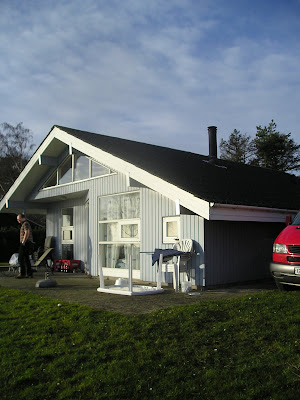
One of Thorsten's friends - Henning - is a master organizer/planner and he had planned everything from the traveling to the cost to the shopping list. One of his ingenious ideas was to break us into cooking groups and each group be responsible for one night of cooking. The first night ended up being my groups turn - which worked out well as we made pizza (only with Fladenbrot, a Turkish flat bread so as not to have to mess with pizza dough).
After dinner we all sat around chatting and playing games. This was in fact how we spent most of our time in Denmark; eating, chatting, playing games, a little bit of tv watching, and during the day in order to enjoy the sunshine and the warmish weather we walked along the beach, and hit some golf balls. Overall it was very relaxing and a good way for me to improve my German language skills - total immersion.
In terms of the games we played, there were the typical card games like speed, Egyptian rat screw, BS, and poker. Then we played some German favorites like set (where you compete against people to make sets of cards based on rules), phase 10 which is sort of like Rummy only the requirements change each round, Cranium (which exists in the U.S. - this was incredibly difficult for me though. Difficult in English as it is advanced vocabulary and imitating celebrities, etc. but in German I'm afraid I was no help at all to my team), and then my personal favorite: Werewolf. I have found an explanation of the game at this website: http://www.eblong.com/zarf/werewolf.html and feel that it is a better explanation than my own would be.

So since the activities were mostly the same for the 3 days I was there, I feel that I can move on and describe our wonderful New Years celebration. Our celebration was traditionally German. The night before New Years we gathered around the Feuerzangbowle (pictured above). The Feuerzangbowle is basically a bowl of Gluehwein but then a metal tray is placed across the bowl and a solid cone of sugar is laid atop the metal tray, doused in rum, and then lit on fire. The fiery sugar melts and deposits itself in the bowl of Gluehwein - delicious! Most Germans celebrate the holiday with Feuerzangbowle and there is actually even a famous movie that is called "The Feuerzangbowle".

On New Years eve we had Raclette (pictured directly above) for dinner. For Raclette everyone gathers around grill objects and gets their own personal pan. Chopped vegetables, cold cuts, eggs, cheese, and whatever else one desires is all laid on the table and everyone then goes about creating their own little pans of food that are then cooked on the grill and eaten. It was a truly delicious item - but as with so many other holiday dishes it did encourage overeating. For dessert we had chocolate fondue. It seemed to compliment the Raclette well - both items containing primarily chopped produce that one makes less healthy by adding cheese (to the veggies) or chocolate (to the fruit).
After gorging ourselves - we settled around the TV to watch a British film (that is apparently loved in Germany on New Years - or Sylvester which is the German word). It is called "Dinner for One" and it lasts about 15 minutes. The movie is about a 90 year old woman who is celebrating her birthday. All of her friends have been deceased for at least 20 years, and so her butler assumes the role of all her friends for this special birthday dinner. Of course that means that he needs to drink for all 4 friends and offer a toast each time a new drink is poured. What follows is that the butler then becomes incredibly intoxicated and does some silly things like continuously trip over a rug, etc. It was entertaining to say the least.
When "Dinner for One" was over it was nearly midnight. We all headed outside to countdown the New Year. After counting down we popped open some champagne, lit sparklers, and wished each other a Happy New Year. Then we went down to the beach and lit off more fireworks. The entire night sky in Denmark was lit up with fireworks . It seemed that nearly every person in this small town was lighting off fireworks in celebration.

Once the fireworks were finished we headed back inside. There we participated in Bleigiessen (The tradition of melting lead over a candle and then dumping it quickly into cold water. The resulting object is supposed to be a "fortune" for the upcoming year) and my object looked like nothing that could be described - who knows what that means in terms of my next year. Once the Bleigiessen was finished we turned our attention back to playing games - all good fun.
Overall it was a New Years to remember. Now of course I am in need of returning to a normal healthy normal diet.
Happy 2008 everyone!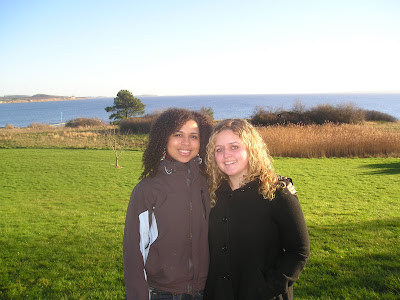
We departed from Braunschweig, Germany on the Saturday before New Years. Two red VW vans, one car, 14 people, and loads of luggage, and food set off for a 5 hour drive (including 1 hour on a ferry) to Faaborg, Denmark. Maya, Thorsten, Thorsten's friend Maike and I were in the car. The time passed quickly - all of us chatting (in German), singing along to music, and car dancing. We arrived in Faaborg, picked up the key to our lovely little house (pictured below), unloaded the cars, and then Maya, Thorsten and I set about making dinner.

One of Thorsten's friends - Henning - is a master organizer/planner and he had planned everything from the traveling to the cost to the shopping list. One of his ingenious ideas was to break us into cooking groups and each group be responsible for one night of cooking. The first night ended up being my groups turn - which worked out well as we made pizza (only with Fladenbrot, a Turkish flat bread so as not to have to mess with pizza dough).
After dinner we all sat around chatting and playing games. This was in fact how we spent most of our time in Denmark; eating, chatting, playing games, a little bit of tv watching, and during the day in order to enjoy the sunshine and the warmish weather we walked along the beach, and hit some golf balls. Overall it was very relaxing and a good way for me to improve my German language skills - total immersion.
In terms of the games we played, there were the typical card games like speed, Egyptian rat screw, BS, and poker. Then we played some German favorites like set (where you compete against people to make sets of cards based on rules), phase 10 which is sort of like Rummy only the requirements change each round, Cranium (which exists in the U.S. - this was incredibly difficult for me though. Difficult in English as it is advanced vocabulary and imitating celebrities, etc. but in German I'm afraid I was no help at all to my team), and then my personal favorite: Werewolf. I have found an explanation of the game at this website: http://www.eblong.com/zarf/werewolf.html and feel that it is a better explanation than my own would be.

So since the activities were mostly the same for the 3 days I was there, I feel that I can move on and describe our wonderful New Years celebration. Our celebration was traditionally German. The night before New Years we gathered around the Feuerzangbowle (pictured above). The Feuerzangbowle is basically a bowl of Gluehwein but then a metal tray is placed across the bowl and a solid cone of sugar is laid atop the metal tray, doused in rum, and then lit on fire. The fiery sugar melts and deposits itself in the bowl of Gluehwein - delicious! Most Germans celebrate the holiday with Feuerzangbowle and there is actually even a famous movie that is called "The Feuerzangbowle".

On New Years eve we had Raclette (pictured directly above) for dinner. For Raclette everyone gathers around grill objects and gets their own personal pan. Chopped vegetables, cold cuts, eggs, cheese, and whatever else one desires is all laid on the table and everyone then goes about creating their own little pans of food that are then cooked on the grill and eaten. It was a truly delicious item - but as with so many other holiday dishes it did encourage overeating. For dessert we had chocolate fondue. It seemed to compliment the Raclette well - both items containing primarily chopped produce that one makes less healthy by adding cheese (to the veggies) or chocolate (to the fruit).
After gorging ourselves - we settled around the TV to watch a British film (that is apparently loved in Germany on New Years - or Sylvester which is the German word). It is called "Dinner for One" and it lasts about 15 minutes. The movie is about a 90 year old woman who is celebrating her birthday. All of her friends have been deceased for at least 20 years, and so her butler assumes the role of all her friends for this special birthday dinner. Of course that means that he needs to drink for all 4 friends and offer a toast each time a new drink is poured. What follows is that the butler then becomes incredibly intoxicated and does some silly things like continuously trip over a rug, etc. It was entertaining to say the least.
When "Dinner for One" was over it was nearly midnight. We all headed outside to countdown the New Year. After counting down we popped open some champagne, lit sparklers, and wished each other a Happy New Year. Then we went down to the beach and lit off more fireworks. The entire night sky in Denmark was lit up with fireworks . It seemed that nearly every person in this small town was lighting off fireworks in celebration.

Once the fireworks were finished we headed back inside. There we participated in Bleigiessen (The tradition of melting lead over a candle and then dumping it quickly into cold water. The resulting object is supposed to be a "fortune" for the upcoming year) and my object looked like nothing that could be described - who knows what that means in terms of my next year. Once the Bleigiessen was finished we turned our attention back to playing games - all good fun.
Overall it was a New Years to remember. Now of course I am in need of returning to a normal healthy normal diet.
Happy 2008 everyone!

The End of Christmas Market Magic
Once again it has been awhile since my last blog posting. With all the time I have on my hands one would think that I would be better about posting, but alas I seem to constantly be procrastinating when I have so much time.
The Christmas Market season is now behind me - taking with it all the festive lights, craft/food booths, and cheery decorations that made the winter season a little less bleak here in Duisburg (and elsewhere). Gone are the days when one could stroll downtown and warm up in the middle of the afternoon with a piping hot mug of Gluehwein (sort of like mulled wine - a favorite here. I am posting a recipe below so that you may try if you wish) and some other tasty treat. There are of course other beverage options at Christmas markets but some of them I recommend steering clear of. For example Eierlikor or Eierpunsch (Egg liquor or Egg punch) cause you to think of egg nog, however, it is quite disgusting in that it tastes quite literally like eggs mixed with vodka or some other type of alcohol. If you are ever in Germany I recommend staying away from the Eierlikor and instead trying the Gluehwein (Glow wine is the literal translation).
During Christmas market season I did have the chance to explore many different culinary treats - both from Germany and abroad. Of course there were the classics that I have already tried like curry wurst (sausage cut into slices and doused in a curry ketchup sauce), Dutch style french fries (served in a paper cone with your choice of sauce), fish and chips (although not deep fried fish like one would expect - a twist on an old classic), and then various assortments of Chinese cuisine. One spectacular treat that I was introduced to was the Peruvian Stuffed Potato. It was found at the Essen (great name for a city with good food considering the word "essen" means food/eat in German) Christmas market and was absolutely amazing. I have since searched the web in order to find a recipe that roughly equates so that those interested (and I myself) may eat them whenever the mood strikes. Here is the recipe:
The recipe for Peruvian Stuffed Potatoes (Papa Rellena)
1/2 pound of hot, cooked, mashed potatoes
1/4 pound of ground beef (or other meat/filling item - at the market they had a mixture of rice, corn, cheese, and ham)
2 diced onions (small cubes about .5 cm thick)
Minced Garlic
Hard boiled eggs - as many as you would like to add to the filling (optional)
Knead potatoes until there are no lumps. Add salt (it didn't specify how much so I'm guessing just a bit to taste).
Heat oil and sautee garlic and onion. Control the heat and add meat (or other filling item). You can also add raisins and/or sliced olives to taste. When meat is cooked remove from heat. Allow the filling to cool.
Divide potatoes into servings (a good sized ball) and flatten with your hands. The potato patty should be about 1/4 inch thick. Potato should be cool. Place filling and optional sliced hard boiled egg into the potato patty. Roll the potato closed and pinch on the ends (I would say make it close to a runza/potato shape). Roll the "potato" in flour. Dip in a beaten egg. Fry the potato in abundant hot oil (my guess is that a fry daddy type item would work the best). When golden brown remove from oil with a slotted turner and place on a paper towel.
Top with a tomato sauce or lemon juice, a drizzle of oil, salt and diced parsley.
Gluehwein (there are of course other variations - feel free to experiment on your own)
1 bottle of dry red wine
1 lemon
1 orange
Cinammon Sticks (2-3)
Whole cloves (a tbsp.)
3 tbsp. of sugar
Cardamom or Ginger (optional and only use in small quantities to taste)
Heat the red wine in a pot (don't boil). Cut the lemon and orange into slices, squeeze slightly over the pot and then add the entirety to the wine. Add the cinnamon, cloves, sugar and a little cardamom (to taste). Heat everything on low and let stand for an hour (or a little longer). DO NOT BOIL!! Before serving strain out the fruit slices and spices and serve in mugs.
These items may have been served at Christmas markets, however, I believe that they go well with any winter day. A little warmth to brighten up the long dark nights. Cheers - or should I say Prost!
Subscribe to:
Posts (Atom)